


Artificial Intelligence: Models, Algorithms and Applications
January 01, 2022
2 min
Personalisation, Customisation, Individualisation, Differentiations
Personalised and customised content has been shown to deliver more dynamic experiences, more user engagements, higher conversion rates, and better customer satisfaction. Two ways help to gear up web applications or mobile applications to achieve a higher degree of user engagement: personalisation and customisation.
For example, see the figure below to understand the difference between customization and personalization.
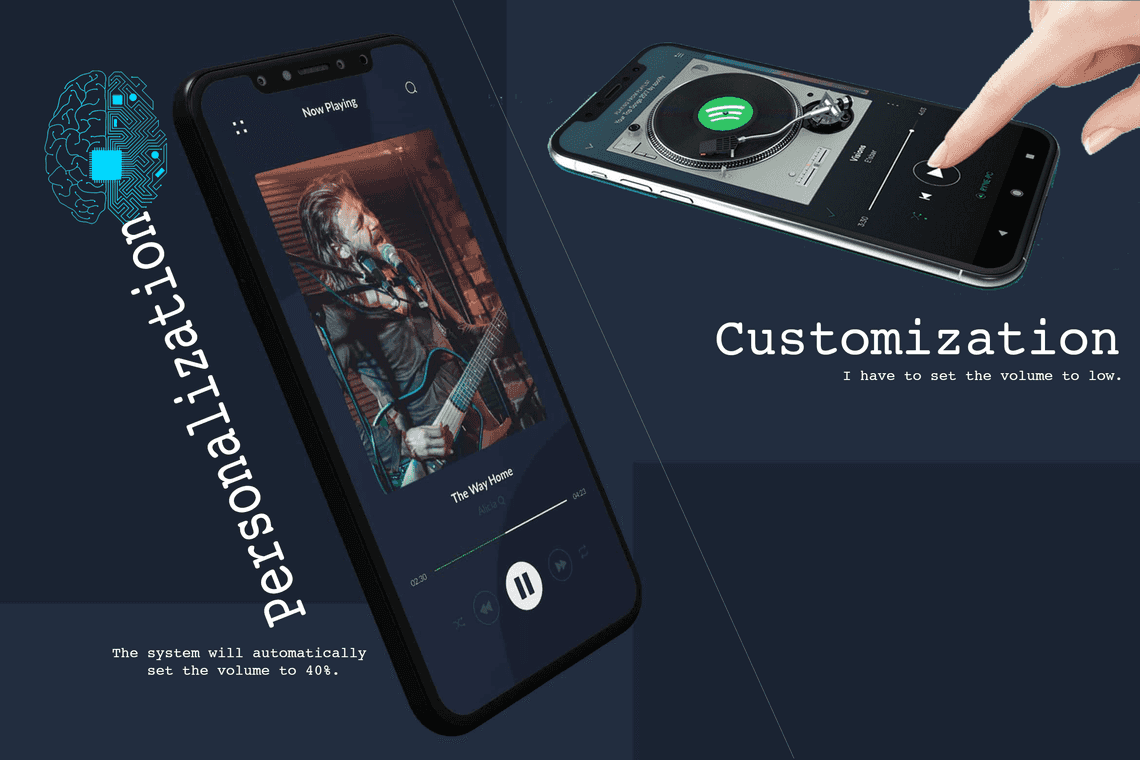
In this context, a personalised app would automatically decrease my application volume, maybe using machine learning algorithms or personalised user profile. A customised app would provide me with an interface where I can decrease the volume. To point out explicitly, customisation requires user intervention. Personalisation auto initiates the system based on user preferences and needs. For example, in this study [1], we use
Natural Language Processingto build personalised treatment of mental health problems using patient-authored text data.
It refers to instruction that is placed to learning needs, tailored to learning preferences, and tailored to the specific interests of different learners.
Segmentation is about groups. These groups are created up of people who share similar characteristics. For example, a) users with same demographics (age, gender, occupation, or income), b) sales stages (awareness, evaluation, loyalty, purchases), c) personas, and others. An essential question to be asked is, why should we care about segmentation?
To comprehend, segmentation allows us to target people in smaller, bite-sized chunks. For example, a company can send email to all people over 50 years of age with blog information about the advantages of consuming newly launched vitamin products. By segmenting these people, we can target each segment separately and tailor information, their presentation and structures according to their most likeliness to increase user engagements.
Simply put, Personalisation is controlled by rules and machine-learning. Segmentation is controlled by the marketer, analysts and managers.
Users are grouped together according to certain characteristics that are well-defined in advance. This is most common on Intranets where HR databases holds substantial data about each employee.
It refers to instruction that is placed to the learning needs of different learners.
They rely on user segmentation model where users are divided into several categories. Based on their individual traits, content is recommended to the particular groups.
ML based personalisation is in hype these days. It requires creating a predicting model that consumes previously stored data and makes a prediction for when new data comes in. If you want to know more about ML, it is just a google away.

According to Netflix, 75% of the their views come from personalised recommendations.
Customisation is the action by a user of modifying something to suit a particular individual need or task. It puts control in the hand of the users by letting them explicitly choose what kind of content or features they want to see. A customised system enable users to make changes to their experience themselves, by tweaking the content they see, or work with.
Main Assumptions: Users know best what their goals and needs are.
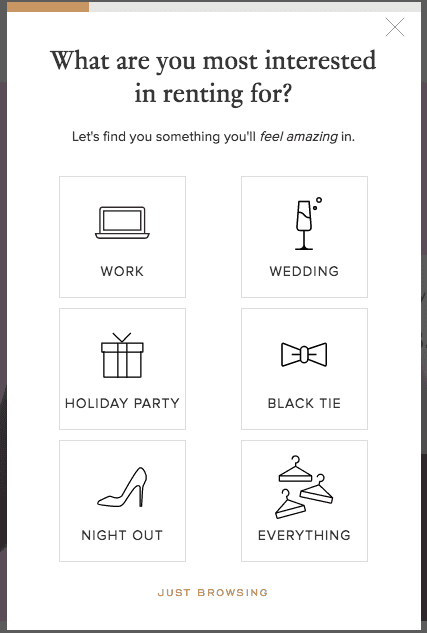
According to a Survey, less than 5% of the users who were surveyed had changed any settings at all.
You can read More about the survey from this link.
There is no one size fits all approach to customising or personalising any application. It depends on the goals and services your application is delivering.
Personalisation is right approach if your site provides users with a large variety of information, content or product choices that they’ll have to wade through to find what they need.
1. S. K. Mukhiya, U. Ahmed, F. Rabbi, K. I. Pun and Y. Lamo, "Adaptation of IDPT System Based on Patient-Authored Text Data using NLP," 2020 IEEE 33rd International Symposium on Computer-Based Medical Systems (CBMS), Rochester, MN, USA, 2020, pp. 226-232, doi: 10.1109/CBMS49503.2020.00050. ↩

Quick Links
Books Authored by Me