


Difference between software architecture and software design
January 24, 2021
5 min
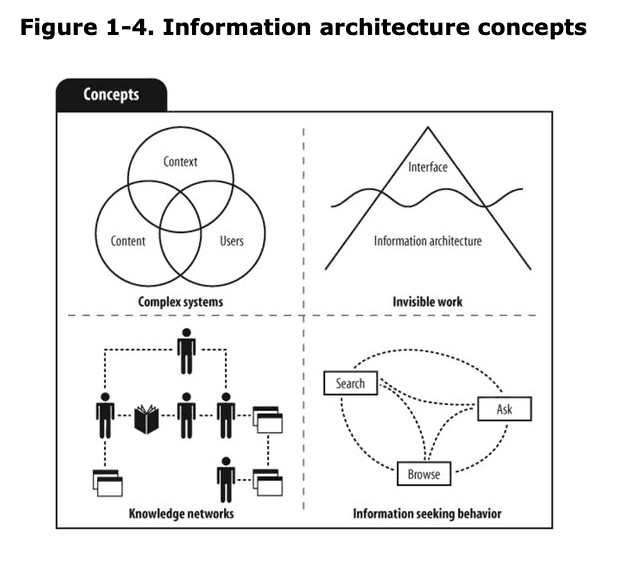
And many more. Well, being full stack web development/ frontend development these not very new terms for me. However, it is important when you present your work to anywhere. The reason is very obvious. As a developer, I can see my hard work, and probably I am clear in my brain how data flows in my small prototype. But it was not clear to my supervisors. Not only because they are much experienced in theoretical aspects but also because code is difficult to market compared to graphical stuffs. Secondly, they suggested me to draw workflow model, domain model, using formal modeling language, draw information architecture.
Software service architecture, RESTful, GraphQL, GraphQL architecture, Query, mutations, resolvers.
I started digging into modeling, model driven software engineering and information architecture. I found two papers and 4 books:
As a part of Ph.D., it is essential to gain both theoratical and practical knowledge. I bought all 4 books and started digging into the theoretical aspects to understand the main principle, concept behind Information Architecture (IA). In this post, I am going to walk you through, the main foundation behind IA in simple way as possible. The content from this post is based on these books, papers and blogs.
Information Architecture (IA) is associated with how people cognitively process information in any Information systems. IA assists experts in the content structuring making it comprehensible and discoverable for the Information Systems users. An American architect and graphic designer, Richard Saul Wurman, is considered to be a founder of the IA field. Currently, there are many specialists working on IA development (https://www.iainstitute.org/what-is-ia).
Current WWW contains a massive amount of information which is hard to structure. Consider following facts:
These statistics reveals prevalence of data and information available today in terms of smartphones, IoT, activity monitoring systems, and other Internet-enabled devices. IoT and smart sensors powered ambient technologies have started to make our life better in many ways, however, it also introduces tremendous challenges. With such massive information available in place, it becomes complex to store, find and understand information readily. IA is the design principle that is inclined on making information discoverable and comprehensible. It solves information explosion by two different perspective:
Why IA matters?
IA is concerned with creating organisational and navigational schemes that allow the user to move through site content efficiently and effectively. The main objective of IA on the web is information retrieval:
It involves creating the architecture directly directly from an understanding of strategy plane considerations: product objectives and user needs. This approach starts with a broadest categories of possible content and functionality required to accomplish the strategic goals, and then breaking down the categories down into logical sub-categories.
A bottom-up architecture to IA derives categories and sub-categories by analyzing the content and functional requirements. Starting with the source material, items of the contents are grouped into logical categories, and then group those into higher level categories forming a structure that reflects our product objectives.
It is about:
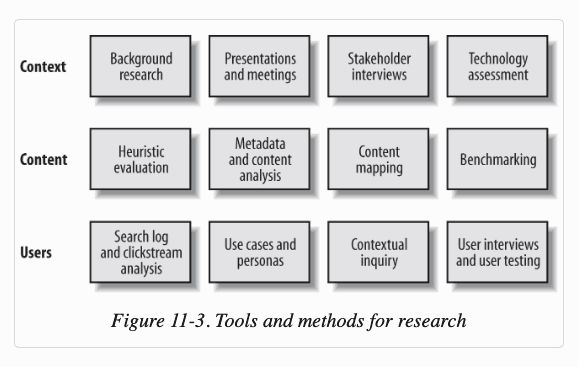
Information ecology [3] describes three major components of IA - user, content and context. Most of the studies uses these components to argue about IA.
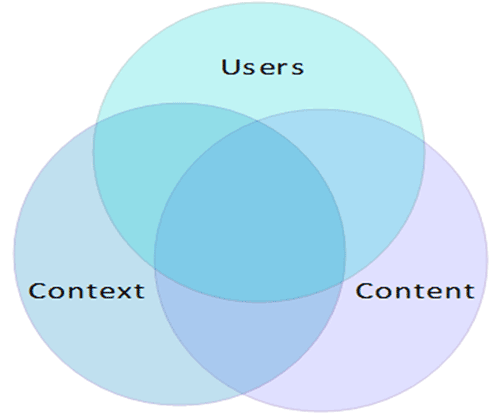
Users need information. This is the reason why they visit your Information Systems. This is the most important truism. Hence, it is essential to understand who end users are. In addition to this, we need to understand their needs. For example, a senior doctor using a medical system has different search preferences than a nurse. The administrator of the same system may need to access all the documents. In the same way, a manager just needs to get executive summary of the systems. Hence, understanding the users, their preferences, behaviours, level of access, roles and permission is essential in defining the structure of the system, search layout, content structure as well as designing adaptive content and layout. Having said that, what are the important questions that should be answered here:
Why is understanding context essential? Well, the most important argument that I can make here is, it answers the question, “what makes your system unique?“. Understanding business context correctly answers this question. Believe it or not, all digital systems have an organisational or business context, whether implicit or explicit. Each system has a goal, a mission, some strategy, staff, processes and procedures, physical systems, technology infrastructure, budget, and culture. This collective capabilities form a unique business context for your application.
Content is anything including documents, applications, schema, tables, meta data, figures, texts etc that end users are interested in. Some of the important aspects of the contents are:
An adaptive web application system for Internet-Delivered Interventions for mental health illness
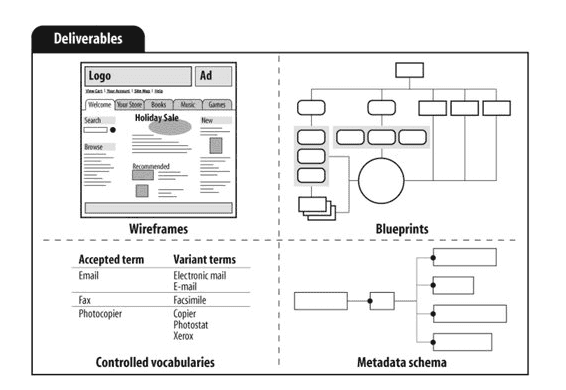
Information architecture is not limited to designing database, taxonomies, search engines, choice of programming languages or layout, it starts with people. There is a reason why people come to your site: they need for information. Hence, it is essential to understand those needs and behaviours and shape our design that correspond according to their need. There is no goal more crucial than designing information architecture that satisfies people’s need.
Again back to our example application for mental health interventions. A patient suffering from depression may be searching for symptoms related to depression and correlate these symptoms with their own symptoms to comprehend their own status. Then our system should allow searching for symptoms, readily and easily. In fact, when user search about symptoms about depression, how about presenting self-assessment questionnaire using MADRAS-S or PHQ-9; which are standard questionnaire for assessing depression. These needs are example for information-seeking behaviours of the users. Distinguishing between these needs and behaviours and determining which of our users’ need has highest priorities is an extremely valuable insight. It not only helps the users but also provides valuable business intelligence to the information system owner.
We integrate searching, browsing and asking technique to find right information. For example, in an IDT, a user first searches about interventions for Depression, if the user finds correct information, the search is finished. If not, the user probably starts browsing the website, going through the navigational links one by one. If browsing does not give them the most relevant information, they will go further and ask the support team/contact team by emailing them/calling them. Information architecture should be designed to support this.
Browsing:
Searching:
Contents
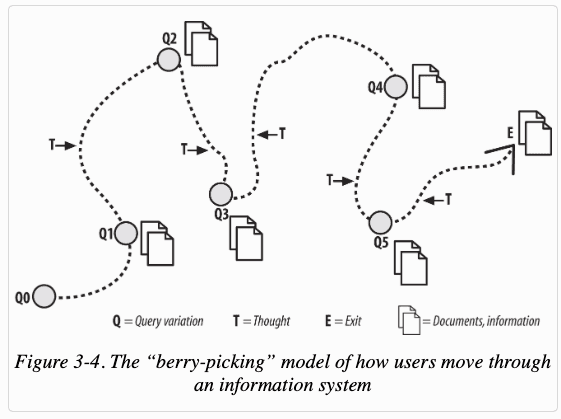
Another information seeking behaviour perspective is, iterative approach. User might not get exact information in first time. But when searching, browsing and asking, our information system can recommend them something that is useful.
Visualisation helps top-business stakeholders and non-technical audience to see and understand basic premise of information architecture. In addition to this, visualisation is important as several studies indicates graphical illustrations are easily marketable.
We organise information so that people can find right answers to their questions, give them context to understand those answers. The freedom to publish on Internet has provided users to create and disseminate information without much organisational paradigm included in it. Why organising information is useful but challenging?
Labelling is a form of representation. For example, “contact us” is a label that represent larger chunk of content including contact name, address, phone number, email address and message.
Labels are often the most obvious way to clearly show the user your organization and navigation schemes across multiple systems and context. Labels educate people about our information system, new concept and help them quickly to identify and find information.
Different forms:
Consistency in labelling system is affected by:
Creating new labels:
It is a mechanism of finding relevant information. There are different types of search algorithms.
Other types of search algorithms:
Search Accuracy
Precision Ratio = Number of relevant documents retrieved/Total number of documents retrieved
Recall ratio = Number of relevant documents retrieved/Total number of relevant documents in the system
Technically both of these terms relate to each other but they are not the same. IA is the blueprint of the design structure which can be generated into wireframes and sitemaps of the project. IA can be used by UX designers to create initial design and navigational systems.
IA focuses on the users’ goals. UX is much more than content structuring, its objective is to make pleasant interaction model so that the users’ feel comfortable using the product.
Research => strategy => Design => Implementation => Administration
Research: Review of existing background materials and meeting with the strategy team, aimed at gaining a high level understanding of the goals and business context. It provides contextual understanding that forms the foundation for development of an IA strategy.
Strategy: It defines the highest two or three levels of the information environment’s organization and navigation structure. It provides high-level framework for the IA.
Design: Shape a high-level strategy into an IA, creating detailed sitemap, wireframes, and metadata schema that will be used by UX designer, programmers, content authors and production team.
Implementation: System building phase where the designs are put into action.
Administration: Continuous evaluation and improvement of the system’s IA.
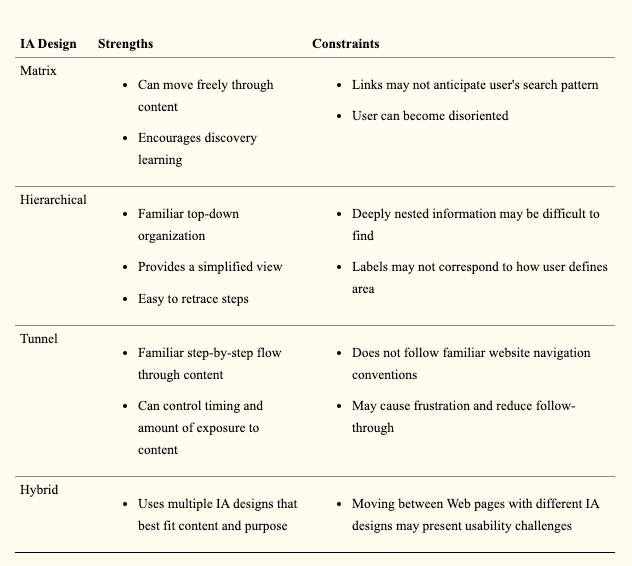
Users follow step-by-step approach in a sequential fashion. For example, while watching a TV series, purchasing an item from Internet Stores, online hotel bookings, online surveys, and others. Almost all e-learning courses are based on tunnel design. Nielsen, a noted Web usability authority, has argued that “…one of the Web’s most powerful features is that it lets users control their own destiny. Users go where they want, when they want… Websites that force users to sit through sequences with nothing to do will be boring and pacifying, regardless of how cool they look” [5].
The linear model is familiar because it is consistent as in movies, textbooks, academic classes, and multiple clinical sessions. The main argument is of its effectiveness is, tunnel based design presents content in sequential steps and is less likely to overwhelm users with information and options.
The tunnel IA design is particularly well-suited to fostering the type of dialog that can be associated with multi-session program in which users are assigned task to do at home on their own in between online sessions.
Example:
Information Systems with matrix IA is designed on the principles of hypertext HTML [6, 7]. In this design IA, users are free to pursue their idiosyncratic interests by using their own path through available content. Such design can be found in government sponsored websites focussed on broad health topics.
The main rationale of its use is, matrix IA offers the maximum amount of information within a system. However, the efficiency is associated with how well the links anticipate users preferences. However, the freedom of movement can be costly as users can quickly become disoriented from original search queries. Lynch and Horton suggested, that a web application with a matrix IA may not be well-suited for helping users. Instead, it should be most applicable for small websites that are designed for highly educated and experienced users who are already familiar with the basic organization of the content and who are visiting in order to obtain further education or enrichment.
Information is organised in top-down manner so that users can review increasingly detailed content. The users is presented with small chunks of information that he/she rapidly explore in a non-sequential manner.
Web applications with such design tend to reduce the kind of confusion that comes from users being presented with too many links and options.
It is combination of one more more IA designs. Hybrid designs have several advantages over websites that offer only the more orthodox matrix or tunnel design. It allows the users to break free from lock-step sequence of pages found in a tunnel design.
IA models information not relationships. Many of the artefacts of IA creation is based on sitemaps, navigations systems, taxonomies and information model are based on the assumptions that a single way of organisation can suit all users. One IA to rule them all. For example, Google’s page rank algorithm was based on folksonomy, compared to Yahoo Directory information architecture model which ultimately become obsolete.

Quick Links
Books Authored by Me